Archive for March, 2010

March 31, 2010

I Don’t Wanna Grow Up

by Katie

I'm not too big

“I don’t know what you’re looking at.  I’m not too big for this bed.”

Really, I'm not too big

“Seriously… it isn’t polite to stare.”

I'm not too big, either

“Do I judge you when you have to lay down to zip your jeans?  Go ahead and try to take this bed away.  I dare you.”

Narcoleptic Puppies

Even they don’t want to admit how fast they’re growing up.

**Disclaimer:  I’ll just go ahead and confess right now that I virtually have no limits when it comes to how ridiculous I can be when it comes to my dogs.

Puppy Butt

Tags:
March 30, 2010

Oh, My Aching Backsplash (Part 2)

by Katie

So we’ve bought all of our supplies, committed to a pattern, and bolstered our confidence.  Sort of.

Now there’s just one thing left to do before we can dive in, and that’s prepping the work area.  Don’t worry, this isn’t as complicated or time-consuming as it sounds.  In fact, many of you won’t have to do anything at all.

In our case the drywall was slightly damaged from removing the old counter and backsplash.  If you recall, the old counter was white laminate with the attached 3” backsplash.  When we pulled off the counter, the top layer of drywall pulled away with the backsplash.

No biggie, except we were left with a thick layer of paint and drywall paper that stopped abruptly where the old backsplash used to be.  All it took to make this surface smooth enough to tile was using my fingers to pull away the loose strips of paint along the edge to make a smoother transition between the old painted wall and the newly exposed wall.

We also needed to move the faucet out of the way so we could easily access the small bit of wall directly behind the sink and below the window.  We left the handle because it wasn’t too imposing and simply taped it off to avoid getting any mastic or grout on it.

Lucky for me, the hubs can plumb.

Plumbing Hubs

The only other prep work we needed to do was to pull out our stove (it’s electric, so as easy as unplugging it and dragging it away), and then screwing a strip of wood we had laying around our garage into the wall in the gap between the two counters that flanked the stove.

Backsplash Prep

We used a level to make sure the wood was nice and straight, and it came right up to the edges of the counter on either side. The purpose of this wood strip was to hold up the tiles – we decided to tile the entire wall behind the stove, even where it was hidden, just to ensure a continuous pattern.  I have Katie over at ABP to thank for this tip – without her, we’d probably have a droopy, saggy tile pattern that falls all askew behind the stove.

You might also notice we’ve taped off the counters with painters’ tape.  In retrospect, I don’t think this was a very good idea.  Let’s just say the tape was… difficult… to remove once everything was said and done.  If you want to protect your counters by using tape, make absatively, posalutely SURE that you do NOT grout over the tape.  Thank you.

You can also see in this photo that we’ve been laying out our tiles.  That is the final – and perhaps most important – part of the prep work.  We started our pattern in the very center of the stove wall and worked out towards the edges to ensure that we wouldn’t end up with any piddly little tiles to cut along either side.  That would look funny.

For the long wall we just laid the tiles out all along the wall to again make sure we wouldn’t have any tiny little slivers of tile pieces in the corner.  Don’t forget to account for your spacers!  (1/8″ in our case.)

Backsplash Prep

Finally, finally we can get to the fun part.

Because we’re lazy smart and bought the pre-mixed adhesive, we were able to dig right in.

Just dip your trowel into the adhesive and start slathering it on the wall.  Like buttah.  Then drag the notched part of your trowel across the adhesive so you get a bunch of raised lines.  You should have enough adhesive on there so that it doesn’t leave any bare spots behind when you drag your trowel across.  It shouldn’t be too thick, either.  You’ll get a feel for it.

Spreading the Mastic

The amount of area you cover at a time with the adhesive depends on how quickly you can lay your tiles (I heard if you give ‘em a couple beers first, they’re a lot easier to lay – har, har).  The point is that you don’t want your adhesive to start drying on the wall before you can lay any tiles over it.

Once you get your adhesive on there, just start squishing on the tiles!  Press firmly to ensure you don’t have any air bubbles.  We opted to lay 2 rows at a time all the way across the length of the wall.  We figured if we worked up instead of across, the top tiles might start to sink down and squish the spaces together in the lower rows.  Just a theory.

Laying the Tile Backsplash

**IMPORTANT NOTE**  We put our 1/8″ spaces along the bottom between the counter and our first row of tiles.  Why?  Most tips we read said to leave this space for your caulk.  You could try to tile right up to the counter if you want, but we figured it might be a little easier to squeeze the caulk into a slightly larger gap.  (Realize I’m saying “caulk” not “grout”.  You do not want to grout between your tiles and your counter top.)

Laying Backsplash Tiles

Just keep going, adding spacers in between each tile.

Laying Backsplash Tiles

If you cover too much of an area with the mastic, just use a putty knife to scrape off the excess.

Laying Backsplash Tiles

If a bunch of your mastic starts oozing up in between the tiles, you’ll want to remove it while it’s still wet.  If it hardens in there, you will curse the day when it comes time to grout.  We found a fantastic specialty mastic-from-crack removing tool (aka. chopstick) laying around in one of our drawers that works great!

Laying Backsplash Tiles

See?  Smooth sailing.  Easy peasy.  Piece of cake with a cherry on top.

Until you have to make the cuts.

Drats.

I wish I had some fantastic tricks to give you for making the cuts.  Really, I do.  But usually a ruler (or in some cases just eyeballing it) did the trick for us.  Then use your tile cutter or saw and go for it!

Hopefully you’re using cheap tiles like us so you don’t cry too hard when you make a mistake.

Cutting the Tiles

Laying Backsplash Tiles

Sometimes you might have to cut around an irregular shape, like a window sill.  That’s where the nippers come in handy.

Laying Backsplash Tiles

Laying Backsplash Tiles

It doesn’t have to be perfect, just close.  The grout will help cover your imperfections.

I love grout.  It’s the ultra pantyhose tummy-tucker support of tiling.

For the edges we decided to cut our bullnose trim pieces in half lengthwise.  We thought they would look nice like that.  And you know what?  They do.

Tile Backsplash Edge

**Note:  This photo was taken BEFORE we realized our tile saw had a guide to help cut straight lines.  Therefore, we had to remove and re-do that top section to get it straight.  The lesson?  Read the damn instructions!

But now it looks great.  Really great.

Part 3 will be the final installment of this little saga (I know, I can’t believe there are 3 parts either).  Unfortunately it will have to wait a bit because we have not yet had a chance to pick up our caulk!

Has anyone else tackled a tiling project like this?

Have you ever wanted to strangle and kiss your tile buddy at the same time?

Do you have any tips I neglected to mention?

Click here to read Part 1 and here to read Part 3 of this tiling saga.

March 29, 2010

Oh, My Aching Backsplash (Part 1)

by Katie

In an attempt to be thrifty DIY-ers and prove that we can, in fact, do anything we set our stubborn little minds to, last weekend we attempted to tile our own backsplash.  Now we’re not complete tiling novices – we conquered the horizontal plane (no, mom, not the way you’re thinking) by tiling our guest bathroom with beautiful porcelain tiles we bought at a fantastic deal from Restore Warehouse.  Unfortunately I wasn’t deep into blogging mode at that point and had only snapped a few photos, but this time I come prepared.

Stack o' Tiles

First let me just say that there is a multitude of resources out there that can show you the way to successfully tiling your own beautiful spaghetti sauce-splattered backsplash.

Minus the spaghetti sauce.

Unless you’re me, in which case there will be plenty of sauce.

We didn’t stick to just one source for this particular project – our sources included plenty of websites resulting from a Google search or two as well as a free tiling class at our local Lowe’s.  We learned a lot, but we finally realized that at some point we just have to go for it and learn what we can along the way.

That said, let’s begin the torture. Er… tutorial.

Oh and by the way, we obviously aren’t pros at this.  I’m sure there are many things we could’ve done differently (aka. better) that a professional tile expert would love to point out.  This is simply the step-by-step process of how we did it, lessons we learned, and how we made it out alive (hopefully).

The first step in this entire process was picking out the tile and pattern.  I looked around online for inspiration pictures that we both liked, and eventually we settled two different patterns – one for the main walls, and the other for an accent wall behind the stove.  Both patterns required some type of rectangular tile, so we knew we could use the same for both.  (The main tiles used in a project are called  “field tiles”.)

We decided not to have any accent pieces because a) I’m really a simple kind of girl, b) there is already a lot going on in our kitchen, and c) that would’ve brought the complication factor way beyond our comfort level.

This is the brick (or subway) pattern we decided on for most of the room:Brick Pattern

This is the herringbone pattern we decided to tackle behind the stove.  Once we got going, it wasn’t as complicated as it looks:

Herringbone Pattern

When it came to the type of tile, there were so many choices.  Eventually it came down to style, function, and price.  But mostly price.  We have the hubs to thank for that.  We ultimately ended up with these nice little 3”x6” ceramic numbers.  At just $2.24 a square foot for the field tiles and $1.74 for each of the trim pieces, they were definitely the most affordable option that still fit into the style of our kitchen.

Ceramic Tile for Backsplash

*Note:  The trim pieces are also 3”x6” – the only difference is one of the long edges is rounded off for a finished look.

Next we had to buy our tiles and other supplies.  The bonus of picking generic ceramic tiles from a home supply superstore meant this was one-stop shopping for us.  You’ll want to buy enough tile to cover the entire square footage of your backsplash plus about 10% to replace those tiles that you might chip, cut incorrectly, break, or otherwise screw up (in our case it was more like 15%).

We broke our fair share of tiles.

Broken Tiles

To do this, measure (in inches) the width and height of your area and multiply those two numbers.  Then divide your total by 144 and you will have your total square footage. We found we had almost 50 square feet to cover!

There are several other supplies you should get if you’re going to tackle this kind of project:

1)  Tile saw or tile cutter.  Tile saws can be pricey but you can also rent them.  They aren’t necessary for ceramic tiles, but you would want to use them for “harder” tile materials like porcelain or stone.  You could also use a tile cutter, which is manual and runs around $20.  We tried one for this project but quickly gave up because we found it was harder (for us) to get straight lines.

Tile Saw

Tile Saw

Tile Cutter

Tile Cutter

2)  Nippers.  These are for clipping the tiles into irregular shapes (to fit them around the window sill, for example).

Nippers

Nippers

3) Adhesive and Trowel.  We used a mastic, which is a pre-mixed adhesive that comes in a tub.  It’s convenient because it’s pre-mixed, but this also makes it a bit more expensive.  We could also use it over the course of a couple days, as long as we kept the lid on tight.  The alternative is thinset, which is cheaper but you have to mix yourself.  The basic rule of thumb is that you should to use thinset anywhere that is likely to get wet (like a shower stall or bathroom floor).

A trowel is the notched tool you use to apply the adhesive to the wall or the back of the tiles.  The size of the notches depends on the type of tile you are using, so ask at your local store!

Mastic and Trowel

Mastic and Trowel

4)  Spacers.  Spacers come in many sizes, and the size you use depends on how wide of a grout line (the space between the tiles) you want.  I wanted thinner grout lines for our patterns, so we settled on 1/8″ spacers.

Tile Spacers

Tile Spacers (1/8")

5)  Grout.  The grout is the stuff that gets applied between the tiles, after they’ve been set on the walls with the mastic or thinset.  You can get sanded or un-sanded grout.  The general rule is that you should use sanded grout for spaces 1/8″ or wider, and an un-sanded grout for spaces 1/8″ or narrower (because it’s easier to squeeze between the cracks).  You can use either sanded or un-sanded for 1/8″ spaces, so we chose sanded grout because it’s a bit easier to work with.

Sanded Grout

Sanded Grout

It’s also important to carefully consider the color of your grout.  There should be a small square of the color on the bag of grout; HOWEVER, you should look for a grout color sample strip somewhere in the grout aisle.  The sample strip contains actual grout samples of each color available for a particular brand, and it will likely be more accurate than the color on the bag.  We actually ended up choosing a different grout color than we originally picked out because it looked so different on the sample strip.

The color you choose depends on the look you’re after – a grout that is darker than your field tiles will really emphasize the tile pattern.  A much lighter grout will make the tiles themselves stand out, and a grout color that blends in with your tiles will have a very subtle effect to make other elements in your kitchen stand out.  We opted for #3.

Grout color

Matching grout color to tile

6)  Grout sealer.  I don’t know much about grout sealer, except for the fact that I convinced myself we need it to avoid staining our grout with all that spaghetti sauce I plan on splashing on it.  We opted for the water-based spray-on stuff because we felt like it would be less toxic fume-wise and easier to apply (maybe we’re just suckers for clever marketing).  You can also get the kind that you wipe on with a sponge.

Tile Sealer

Grout Sealer

7)  Caulk.  You will need to put some type of caulk between the tiles and the counter top (and any other exposed tile edges) to finish everything off.  In most cases you will want to match your caulk to your grout if at all possible.  I don’t have a picture yet, because I haven’t bought any!  This is essential for completing the project.

8)  Another thing (almost) essential for completing the project is a tile buddy.  It’s a wonder our various tile projects haven’t culminated in divorce, but the stress, arguments and mess-ups all seem far away when you’re finally done and admiring your handiwork over a cold beer.  Or two.

This is my tile buddy:

Tile Buddy

Tile Buddy

He’s a good buddy indeed.

Tile Buddy

Nice buddy.

That’s it!  Next time we’ll get to the fun part – the part where we get dirty.

Click here to read Part 2 and here to read part 3 of this riveting saga.

March 28, 2010

Get Your Filthy Paws off my Silky Drawers!

by Katie

Since remodeling our kitchen, I have decided that drawer bases (aka. base cabinets with drawers instead of doors and/or pull-outs) are the best. thing. ever.

I can now store my empty food storage containers with the lids on.

Kitchen Drawer Tupperware Organization

Now that I’m embracing this whole domesticity thing, you have no idea how much pleasure this gives me.  It gives me the kind of pleasure that used to require a battery.  And I’m not talking about a dust buster.

I no longer have to pull heavy plates down from the wall cabinets over my head.
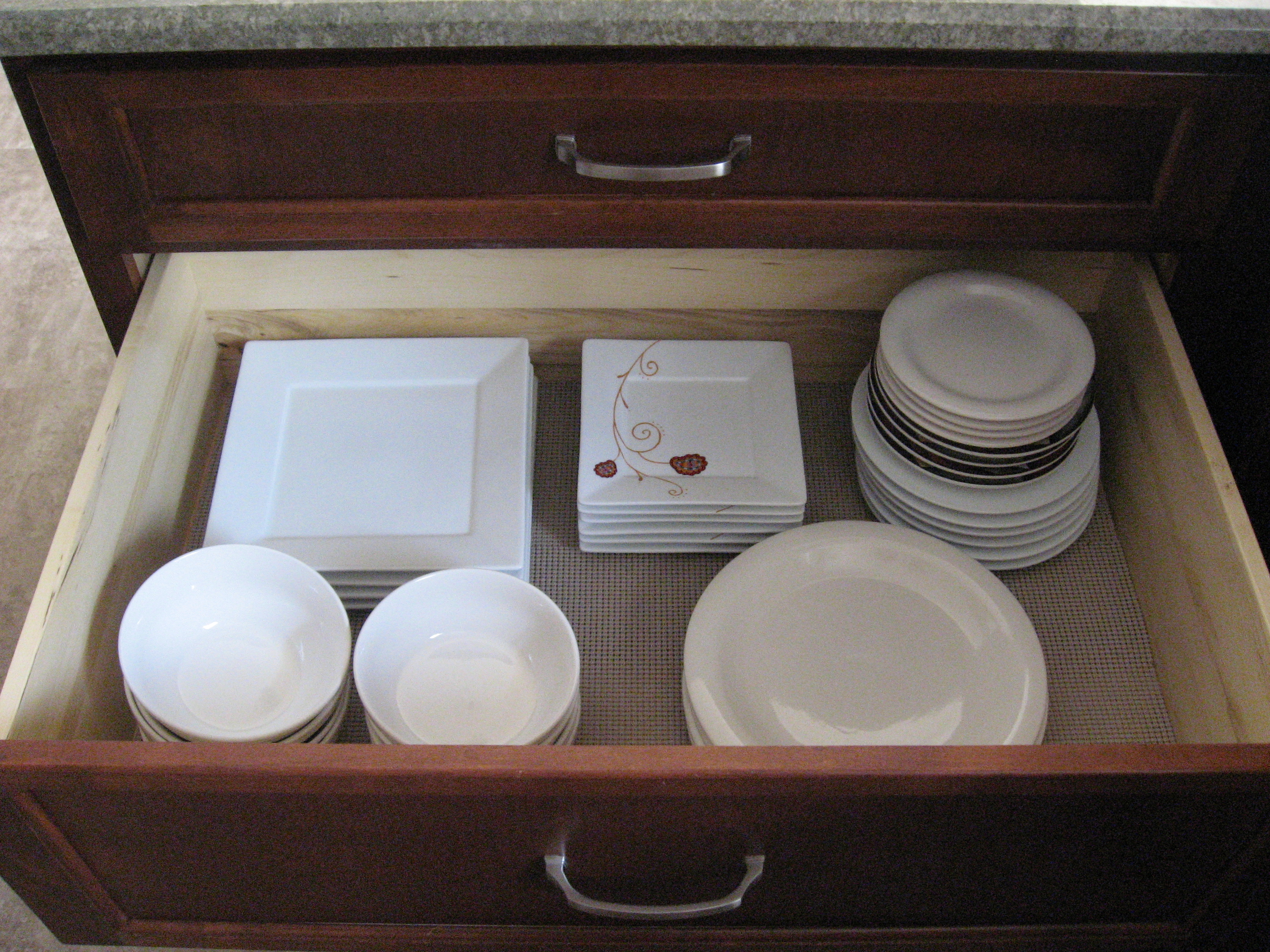
Kitchen Drawer Dinnerware Organization

My utensils, plastic wrap and storage bags?  All conveniently near the food storage containers, dinnerware, and refrigerator.
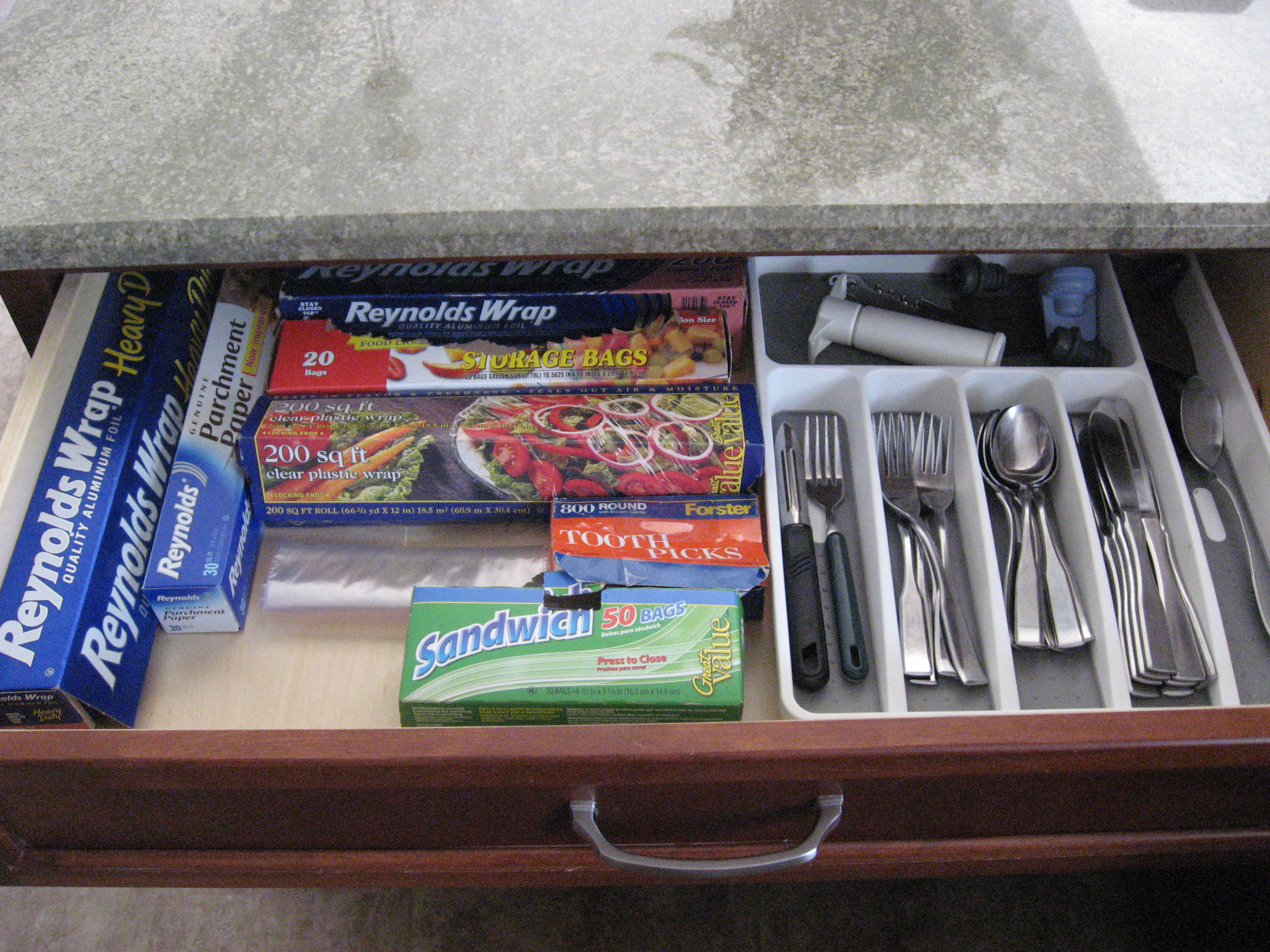
Kitchen Drawer Utensil Organization

And I no longer need to crawl inside my cabinets to reach my baking dishes, pots, pans or their matching lids!
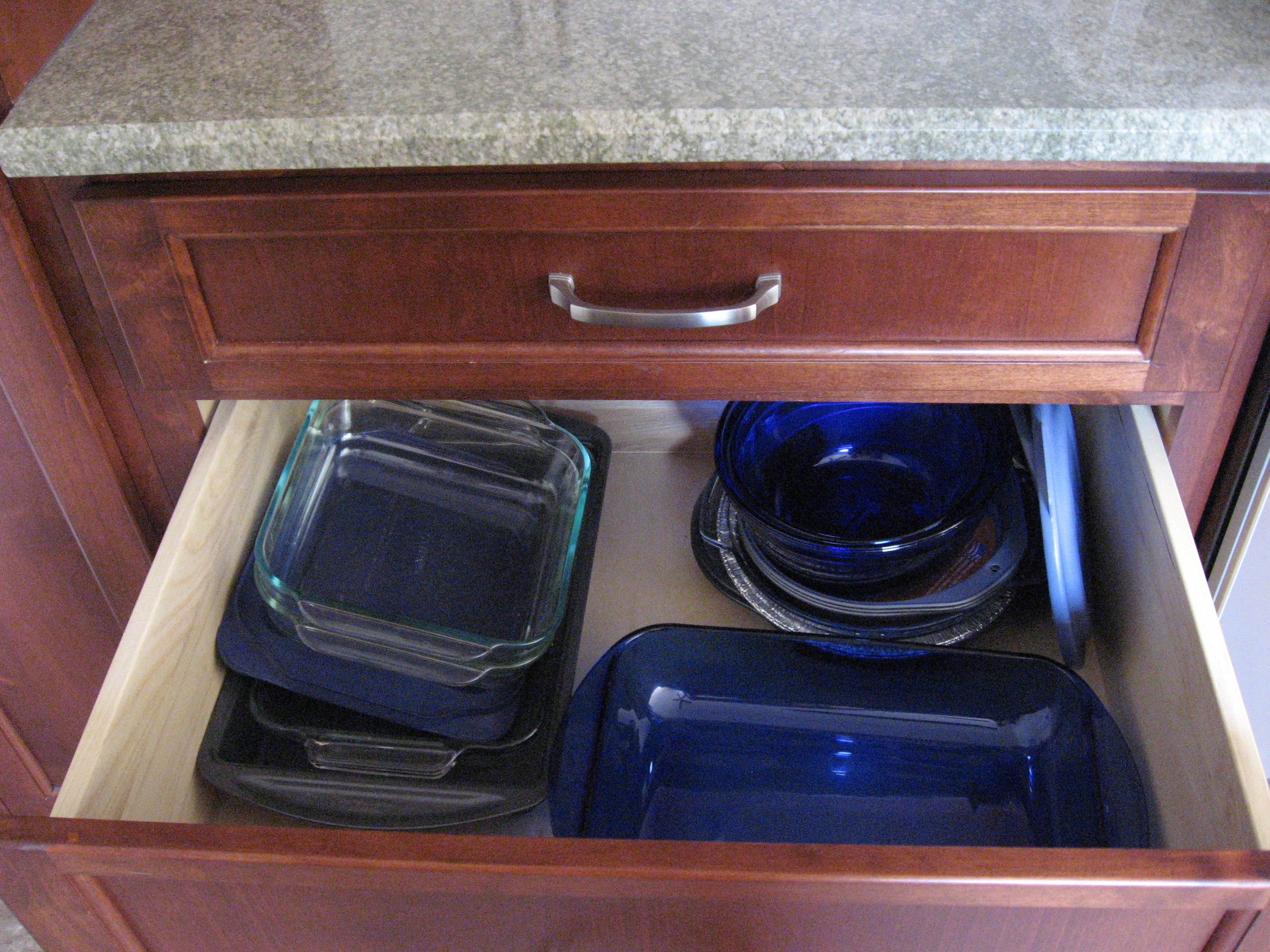
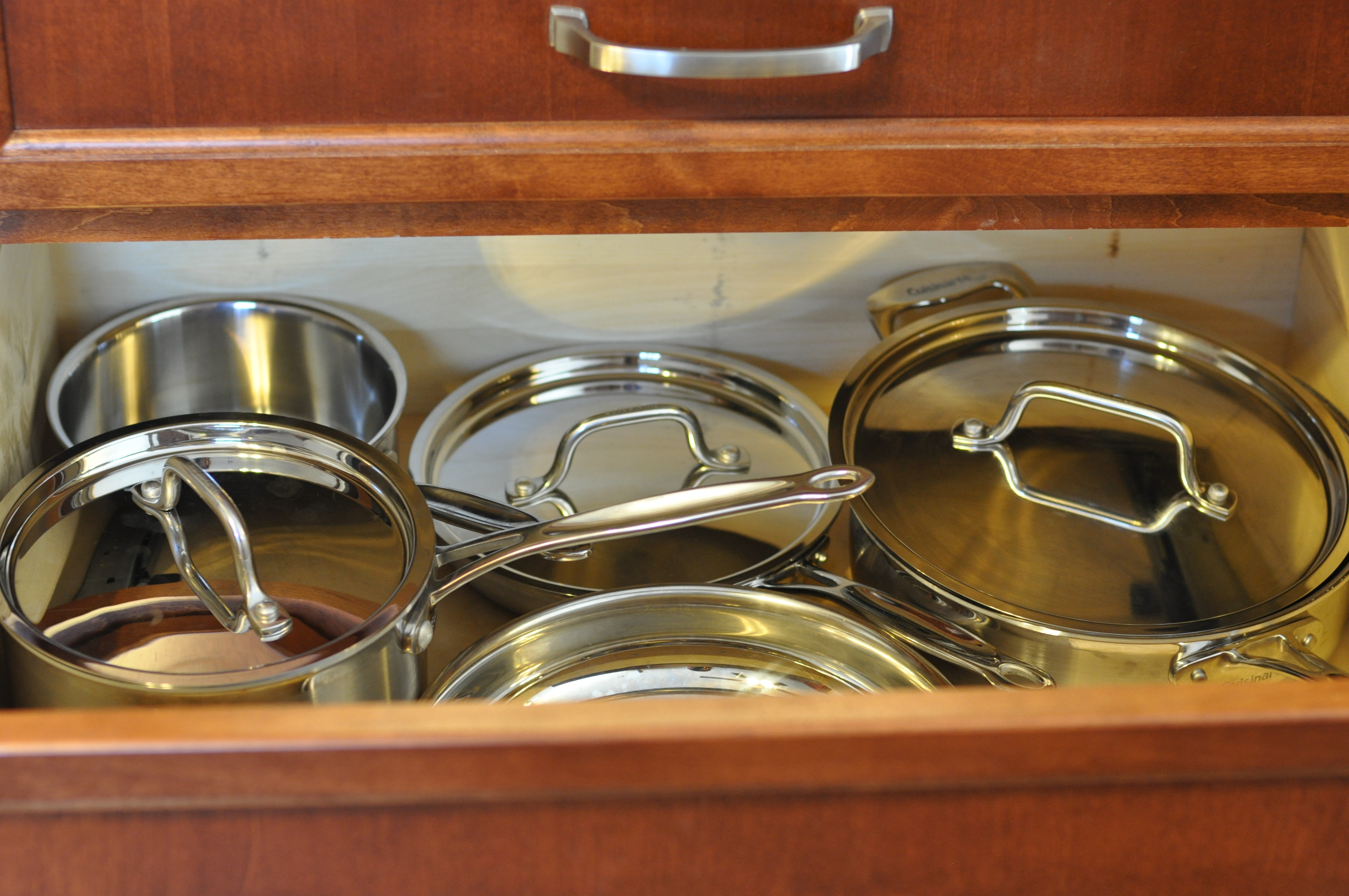
Kitchen Drawer Bakeware Organization

Kitchen Drawer Pots and Pans Organization

Kitchen Drawer Pots and Pans Organization

Finally… finally… no need to lift the spices one-by-one to read the labels.

Kitchen Drawer Spice Organization

And the cooking utensils aren’t collecting dust in a container on the counter!
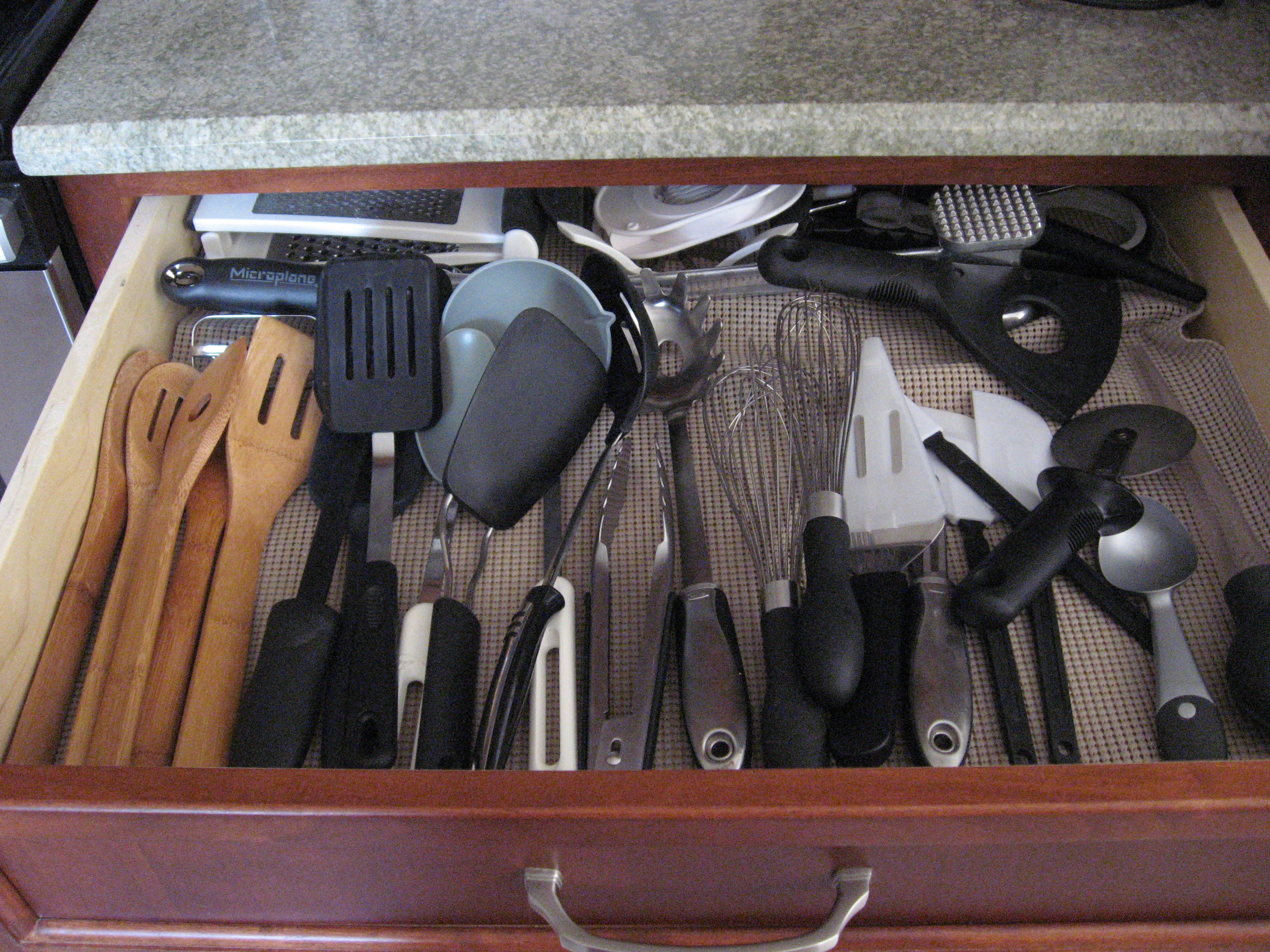
Kitchen Drawer Cooking Utensil Organization

There’s an added bonus, you say?  Maybe one of the best parts I’ve discovered about these huge storage drawers is that they really don’t require expensive interior dividers.  All it took was some cheap cabinet liner from the dollar store, and viola!  Instant organization.  The plates don’t slide around, and the spices don’t roll and spill throughout the drawer.

Who knew this could make me so happy?

Looks like I might need a little travel adventure to put things back into perspective…
